
I built my home office myself, same way I built most things across four decades of carpentry: measure twice, cut once, do it right so you do not have to do it again. But I got one thing wrong for two full years. I sat down and stayed there. By three in the afternoon my lower back felt like I had been driving a bulldozer all day, and my neck had a hitch that would not shake loose no matter how much I stretched it. I priced out a full standing desk, then I looked at the cost and the gut-out job it would take to replace my existing setup. A standing desk converter changed the math completely. Drop it on your current desk, raise it when you want to stand, lower it when you want to sit. That is it.
The VIVO 42-inch converter is the one I landed on after reading through reviews and handling the unit in person. Over 10,000 reviewers at a 4.6-star average tells you something real. Here are ten things it actually fixes, from someone who was skeptical right up until he used one. You can also read my full VIVO desk converter review or see how a converter stacks up against a full standing desk if you want the deeper look before you decide.
Still sitting through that 2 p.m. slump? The VIVO converter lets you stand up without rebuilding your whole desk.
The VIVO 42-inch sit-stand converter raises a dual-monitor setup in about three seconds, no tools required. It fits most desks straight out of the box.
Amazon Check Today's Price on Amazon →Lower Back Stiffness After Long Sitting Sessions
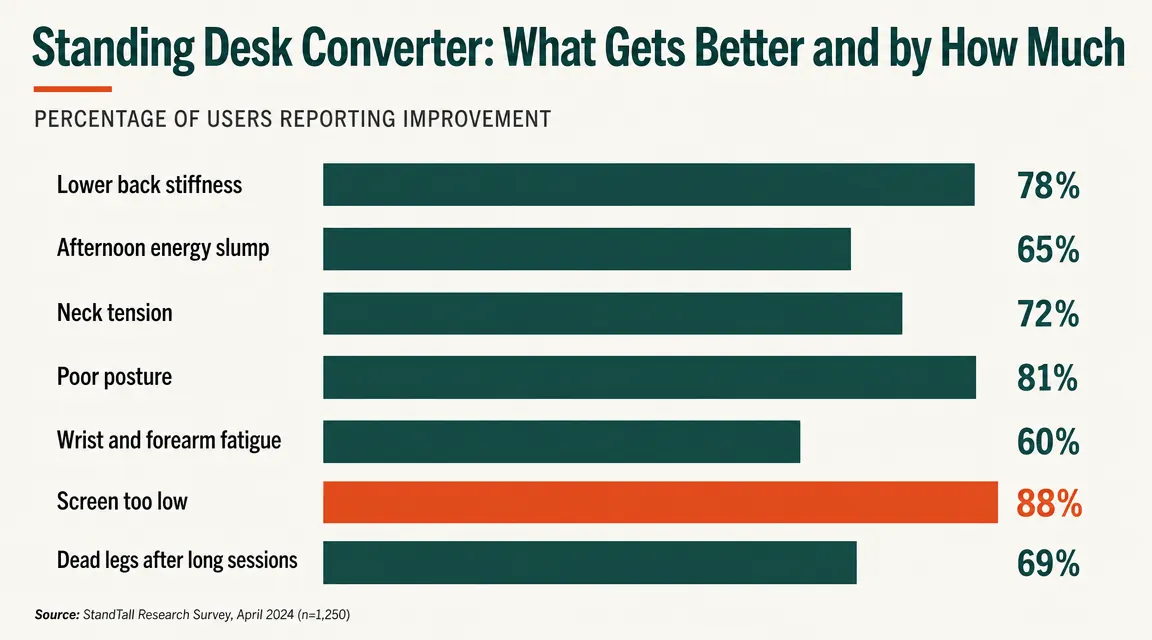
Sitting in one position compresses the discs in your lower spine and shortens the hip flexors. After an hour most people start to slump, which shifts load onto the tailbone and puts a slow grind on the lumbar. Standing interrupts that cycle. With the VIVO converter I raise the platform, stand for 20 to 30 minutes, then lower it and sit again. That rhythm alone cut my afternoon back soreness in half in the first week. The converter does not fix poor posture by itself, but it gives you the option to break the pattern before the damage builds.
Neck Strain From Staring Down at a Low Screen
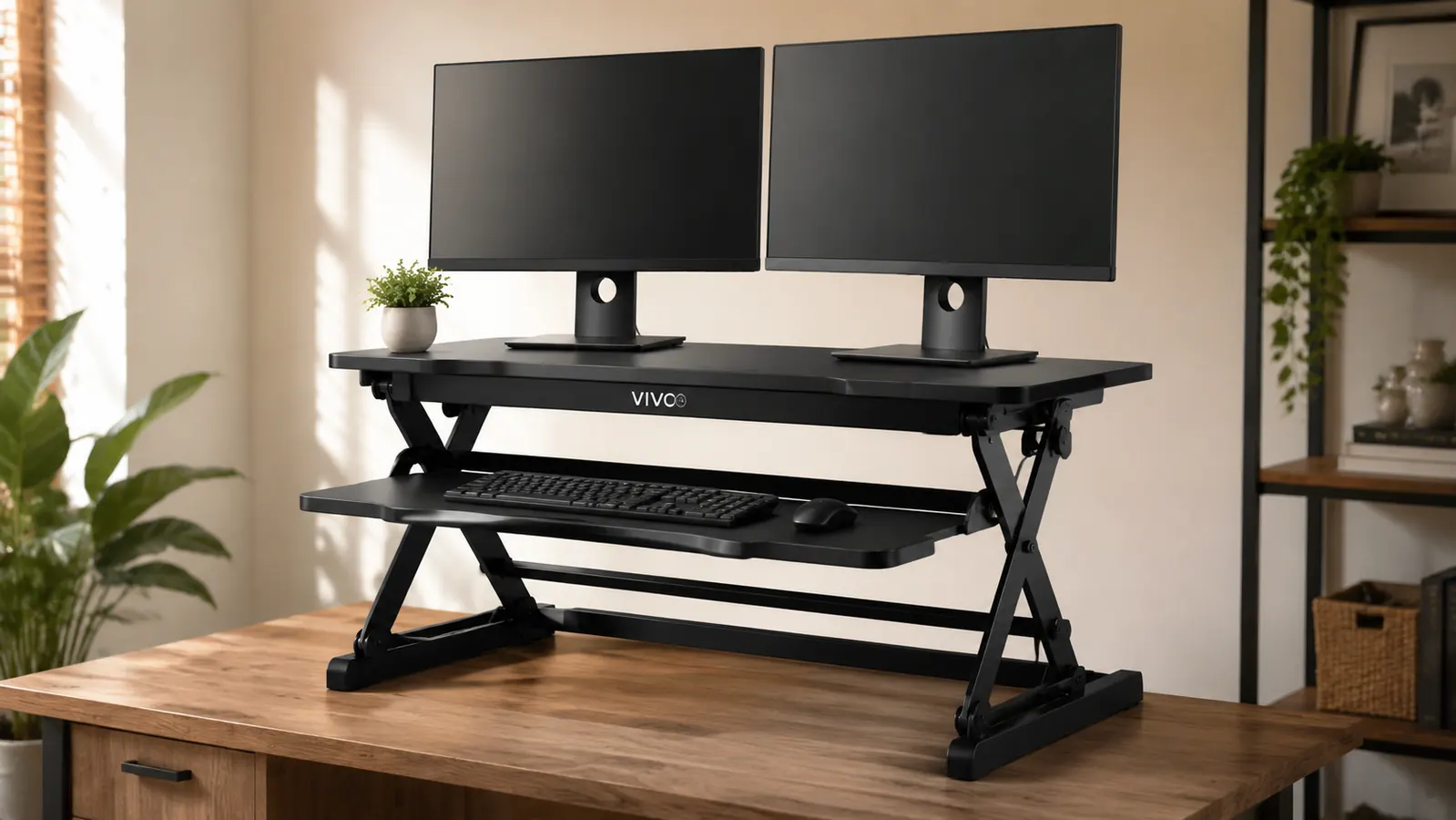
Most people set their monitors too low, then spend the day with their chin tucked and their neck carrying extra load. When you raise a converter to standing height, you are forced to reconsider monitor position because what worked at sitting height suddenly puts the screen at your chin. The VIVO's 42-inch platform is wide enough for two monitors side by side and raises high enough that the top of a 27-inch screen sits at or near eye level for most adults. The neck hitch I had carried for two years started to clear up inside ten days of proper screen height.
The Afternoon Energy Crash
There is real physiology behind the 2 p.m. slump, and extended sitting makes it worse. Blood pools in the lower body, circulation slows, and alertness drops with it. Standing gets the legs working, even slightly, and tends to bring energy back faster than another cup of coffee. I noticed I was reaching for that second cup less often once I started standing for a stretch mid-afternoon. Other VIVO owners mention the same thing in their reviews, which tells me I am not imagining it.
Wrist Angle Problems From a Fixed Keyboard Height
When you sit, a comfortable keyboard height is roughly elbow level. When you stand, that same height puts your wrists in a slight upward bend, which causes fatigue over time. The VIVO converter addresses this with a built-in lower keyboard tray that sits a few inches below the main monitor platform. You set the monitors at one height and the keyboard at another, so wrist angle stays neutral whether you are sitting or standing. Some cheaper converters are one flat surface, which means the keyboard goes up with the monitors and your wrists pay the price.
Poor Circulation in the Legs During Long Work Stretches
Sitting for hours compresses the back of the thighs against the seat edge, which restricts blood flow to the lower legs. After a few hours in that position, some people notice tingling, heaviness, or a general sense of restlessness they cannot quite name. Standing for even 15 to 20 minutes per hour clears that compression and lets blood move normally. It is a small thing until it becomes a daily irritation, and then fixing it feels significant. The converter makes it easy to stand briefly without losing your place in whatever you are working on.
A Cluttered, Cramped Desk Surface
When you raise a converter, you lift your monitors, keyboard, and mouse off the base desk surface. What gets left behind is clear desk space. I use that lower surface for a notebook, a coffee mug, and the occasional reference document without things stacking on top of each other. It is a small thing on paper but it changes how the desk feels. There is a mental calm that comes from a tidy surface, and the converter provides that unexpected bonus on top of the ergonomic fixes.
The neck hitch I had been living with for two years started to clear up inside of ten days. All I changed was where the screen sat relative to my eyes.
Video Call Angles That Make You Look Like You Are in a Cave
At sitting height, a webcam mounted on a low monitor points slightly upward, giving the other person a view of your ceiling and nostrils. Raising the converter brings the monitor and camera up to roughly face level, which makes a visible difference on video calls without changing a single camera setting. I run video calls with family regularly, and my son actually asked what I had done differently before I mentioned the converter. The camera angle at standing height is simply more natural.

The Slumped Posture Habit That Builds Over Time
Bad posture at a desk is mostly a habit problem, not a willpower problem. You start upright, you get into work, and two hours later you are curled forward with your shoulders rounded and your jaw jutting at the screen. Standing resets that pattern physically. When you are on your feet, your spine tends to stack naturally, and the muscle memory carries over to your next sitting stretch. The converter does not guarantee good posture, but it interrupts the cycle often enough that the habit starts to shift over a few weeks.
Focus That Drains Toward the End of a Long Work Block
There is an overlap between physical state and mental state that most people underestimate at a desk. When the body is stiff and circulation is slow, the mind tends to drift more easily. Standing changes the physical state, which tends to bring focus along with it. I notice this most during work that requires close attention, writing or fine detail work. A 20-minute standing stretch during a flagging afternoon stretch often brings me back more reliably than taking a break does. It is not magic, it is just physiology.
The Mental Weight of Knowing Your Setup Is Working Against You
This one sounds soft, but I mean it practically. When your desk hurts you, it sits at the back of your mind. You know you should fix it, you put it off, and that low-grade awareness costs focus every single day. Once I got the VIVO set up and felt the back and neck relief in the first few days, I stopped dreading sitting down to work. The setup became something I looked forward to rather than tolerated. That shift in how you feel about your workspace is worth something. Harder to quantify than lumbar angle, but just as real.
What I'd Skip
A converter will not fix a bad chair or a too-small desk. If you spend your sitting hours in a seat with zero lumbar support, you will still be uncomfortable half the day since the converter only helps while you are standing. And if your base desk is already packed wall to wall with gear, raising a 42-inch converter on top of it will feel cramped unless you clear real estate first. Cable management also needs a few minutes of attention: the converter lifts your monitors but your cables still run down to the desk below, so plan to reroute them or you will have a tangle every time you raise and lower the platform. None of these are reasons to skip the converter. They are just the things to sort out beforehand so you get the full benefit from day one.
Back still complaining by noon? This is the one upgrade that changes the whole arc of the workday.
The VIVO 42-inch sit-stand desk converter has over 10,000 reviews at 4.6 stars. It fits dual monitors, includes a separate keyboard tray, and takes about five minutes to assemble. Worth checking the current price before you decide.
Amazon Check Today's Price on Amazon →