

I built my home office two years ago, and I did it the way I do everything: I planned the wood, the cable runs, the monitor placement. Then I slapped a cheap clip lamp from the hardware store onto one corner and called it done. By four in the afternoon, my eyes felt like I had been staring into headlights. By five, I had a dull headache sitting right behind my temples. I lived with that for about six months before I admitted the lamp was the problem. The Lepro LED desk lamp is what I replaced it with, and I have been using it every single day for the past eight months. At $26.99, I figured even if it was only half as good as the marketing, I was still ahead. It turned out to be a lot more than half.
This is the Forbes Vetted Best Task Lamp, according to the Amazon listing. I will be honest: that badge made me raise an eyebrow. I have seen a lot of 'vetted' labels that turn out to mean nothing. But I bought it anyway because of the metal construction and the five color temperature modes, which told me someone had actually thought about how real people use a work lamp at different hours of the day. Eight months in, I have an opinion worth sharing.
The Quick Verdict
A well-made metal task lamp at a price that makes its plastic competitors look overpriced. Five color modes and smooth dimming fix the most common cause of home-office eye strain. The arm could lock a little tighter, but this is a lamp I would buy again without hesitation.
Amazon Check Today's Price →Your lamp is probably why your eyes hurt by 4 PM. Here is a $27 fix.
The Lepro is metal-built, Forbes Vetted, and has five color modes so you can match the light to the hour. Check the current price on Amazon before it changes.
Amazon Check Today's Price on Amazon →How I Have Used It
My desk sits in the northeast corner of a spare bedroom, under a single overhead light that points at the back of my head and creates a shadow right where I need to read. The Lepro sits at the left rear corner of the desk, arm extended forward and angled slightly down, pointed at the keyboard and the notebook I write in longhand before I switch to the computer. I run it three to eight hours a day, five or six days a week. In the morning I use the 4000K neutral white mode. In the afternoon, if the outside light gets dim and I have reading to do, I step up to 5000K. By seven in the evening, when I am doing lighter work or just keeping a lamp on for company, I drop it to 3000K warm white and dial the brightness down to about 60 percent.
I also use it for detail work at my secondary table, the small bench off to the side where I do occasional woodworking repairs, puzzles with my granddaughter, and some amateur watercolor painting. For close detail work, 6500K cool daylight at full brightness is the mode, and the lamp handles it without blowing out the color of the materials I am looking at. That range from 2700K to 6500K is not a marketing number. It is genuinely useful in daily practice.
Build Quality: What You Are Actually Getting for $27
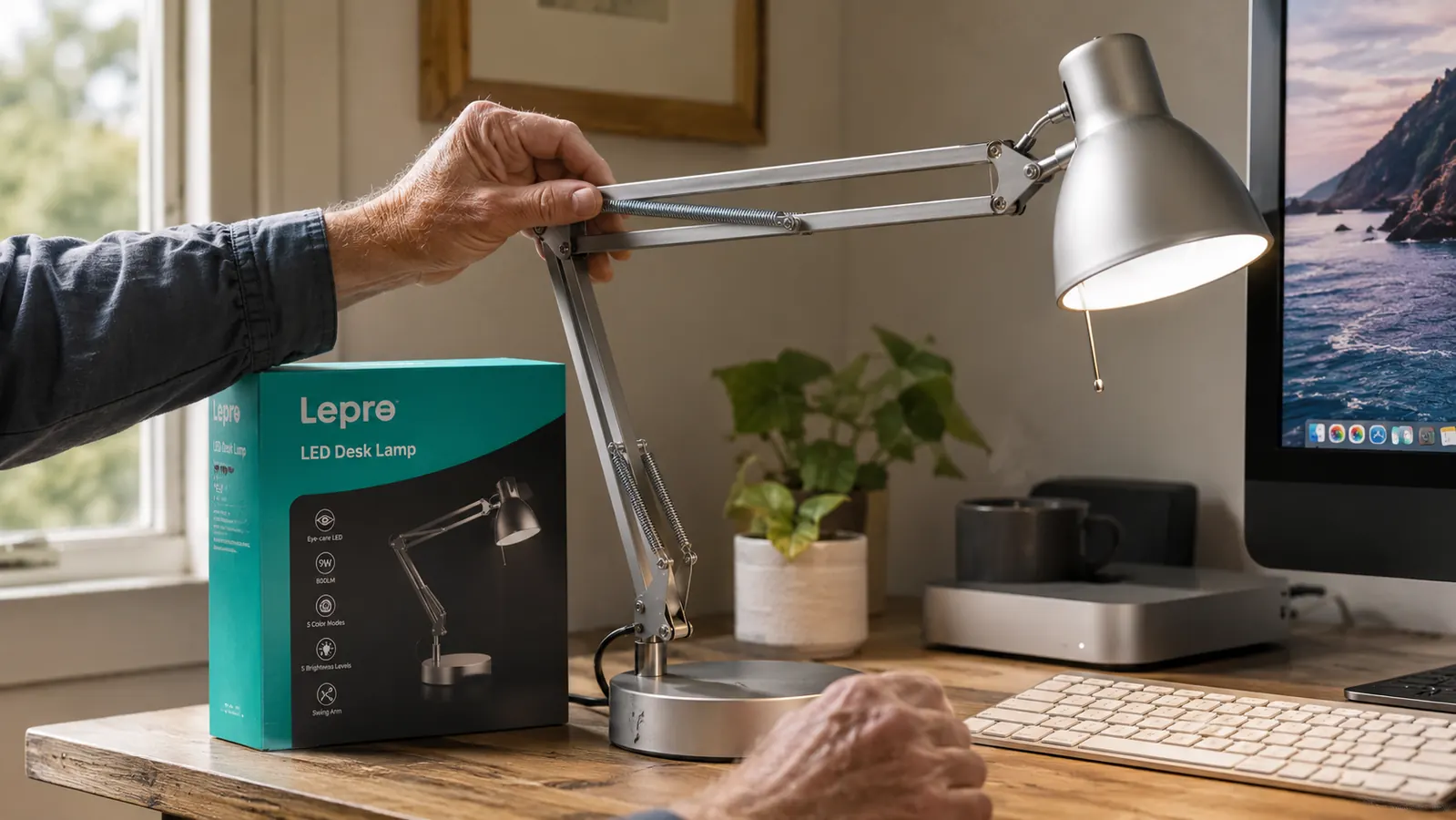
The lamp head and arm are brushed aluminum. The base is weighted metal, heavy enough that the lamp does not slide or tip when you are repositioning the arm. Coming from a trades background, I notice construction details that most people walk past. The joint between the arm and the head moves on a firm hinge, not a plastic friction clip. The base-to-arm connection is the same way. When you set the angle, it holds. It does not drift down over the course of a workday the way the cheap spring-loaded lamps do.
The arm has two pivot points and a single horizontal axis at the base. You can reach forward about 18 inches from the base, and you can tilt the head from nearly vertical down to about 30 degrees above horizontal. That range covers the real-world positions you actually need, whether you are lighting a keyboard, a book laid flat, or a work surface off to the side. My one note: the upper arm joint is a little stiffer than the lower. It loosens up over a few weeks of use, but out of the box you will push on it and wonder if something is wrong. Nothing is wrong. It just needs to be broken in like any good hinge.
The LED panel inside the head measures about 4.5 inches across, which gives a wide enough spread to illuminate a keyboard and a notebook simultaneously. At 800 lumens on the highest setting, it is bright enough that I have never once wished for more power. For reference, a 60-watt incandescent puts out about 800 lumens too, but it scatters light in every direction. This lamp directs it forward and down, so it feels brighter in use than the number suggests.
The Five Color Modes in Practice
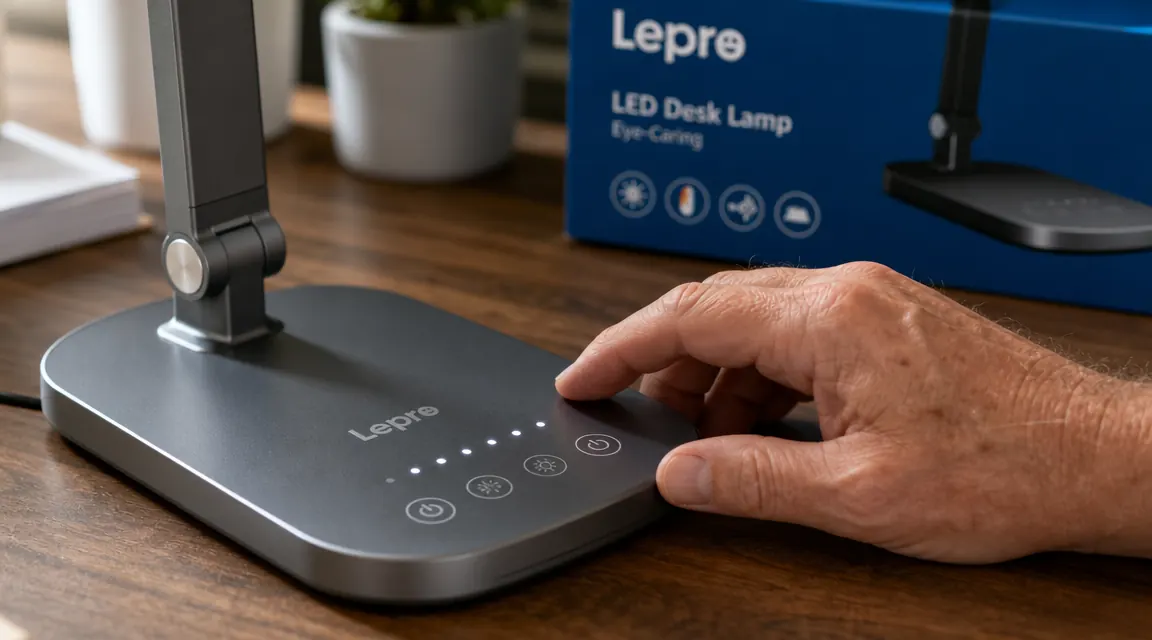
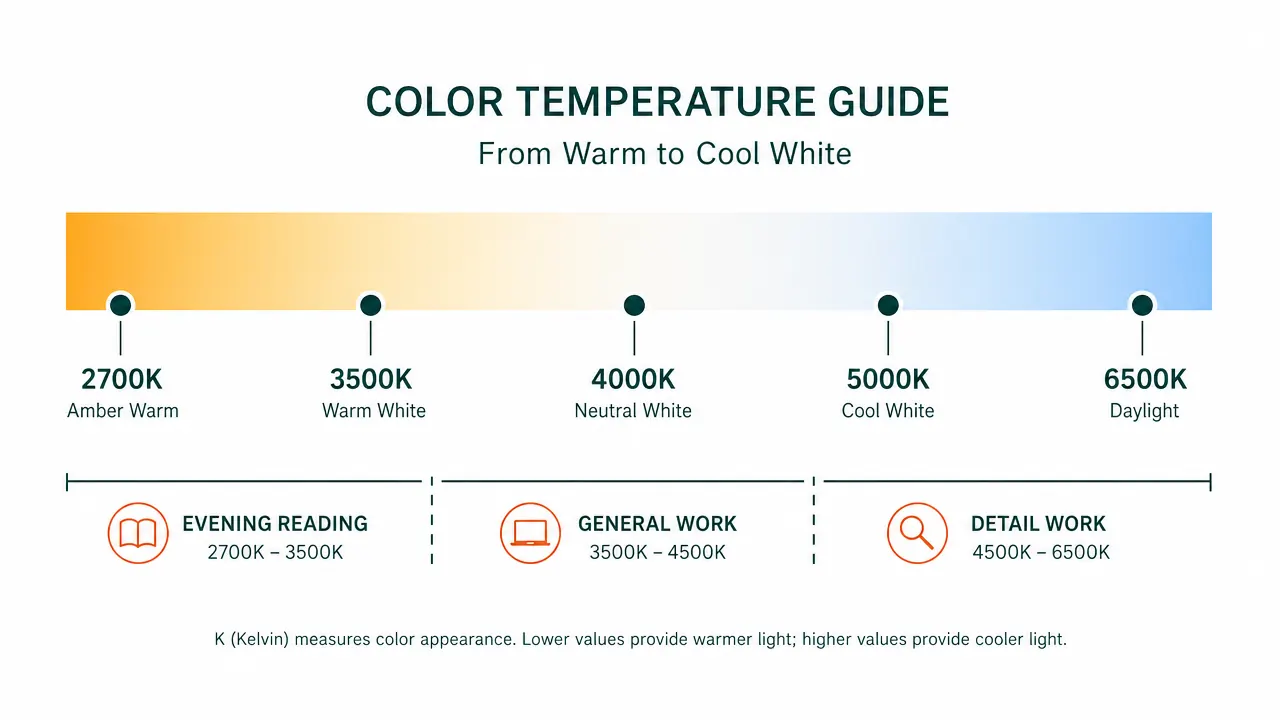
Most budget desk lamps give you one color temperature, usually a blueish white that is fine at noon and harsh by sundown. The Lepro has five: 2700K, 3000K, 4000K, 5000K, and 6500K. You cycle through them with a single touch on the base control panel. Each one is a real, perceptible step, not a subtle shift you have to squint to detect.
The 2700K warm white is the mode I use the most by hours. It is close to the color of incandescent light and it does not fight with the yellow-toned overhead in my room. It is genuinely relaxing without being dim. The 4000K neutral white is my default for active work, close to noon daylight, which keeps me alert without the clinical feeling of the cooler settings. The 6500K mode is the one you want for reading very fine print, sewing, detailed paperwork, or anything where you need every edge of contrast you can get.
The dimmer is a touch slider on the base, five brightness steps. It responds on a single tap and steps through without hesitation. After eight months, no degraded response, no ghost touches, no flicker at the low end. That last part matters more than people realize. A cheap lamp at 20 percent brightness will often flicker in a way that is just below what you consciously notice but that still tires your eyes. The Lepro does not do that. Steady light at every brightness level.
Eye Strain: The Reason Most People Buy This Lamp
The headaches I had with my old clip lamp stopped. I want to be careful here and say that I am one person with one desk in one room, and your experience could differ. But the change was obvious enough that I noticed it within the first week. By the end of the first month I had stopped reaching for ibuprofen in the late afternoon, which had become a daily habit I had barely registered as abnormal.
By the end of the first month I had stopped reaching for ibuprofen in the late afternoon. That had become such a routine that I barely recognized it as abnormal until it stopped.
The combination of things that makes the difference: no flicker, a wide and even light spread that does not create hard shadows across the keyboard, and the ability to warm the color as the afternoon light outside shifts. That last point matters more than I expected. I had not realized how much my eyes were working to adapt between a cool desk lamp and warm ambient room light. When those two are matched, the adjustment disappears.
If you are looking for more on the lamp placement side of this, I have a separate piece on how to light a home office without screen glare that goes into positioning specifics. The lamp gives you the right light. Where you point it is your part of the job.
What Could Be Better
The arm joint at the top, as I mentioned, is stiff at first. That is not a defect but it is something to know. The power cable is about 59 inches, which is enough for most setups but not quite long enough if your nearest outlet is behind a desk that is pushed against a wall. I ended up routing mine through a cable management channel. Not a dealbreaker, but worth measuring before you finalize desk placement.
There is no memory function. Every time you turn the lamp off and back on, it returns to 4000K at mid-brightness. For most people that is fine. If you have a very specific setting you use every time, you will press two or three buttons to get there at startup. That is a 10-second inconvenience at worst. But if you are used to a lamp that remembers your last setting, it will feel like a step back.
I also wish the arm could extend a few more inches forward. Fully extended, the head sits about 17 or 18 inches from the base. For a deep desk, that is fine. For a shallow desk where the base sits close to you, you may find you want more reach. I have a 30-inch deep desk and the lamp sits at the rear edge, so the reach is not an issue. If your desk is 24 inches deep, measure first.
How It Compares to What Else Is Out There
There are two categories of desk lamps. The first is the $15 to $25 plastic lamp with one color temperature and a fixed neck. These are fine for a teenager's homework and nothing else. The second is the $80 and up territory, which includes things like the BenQ ScreenBar, a monitor-mounted light bar that costs three times as much and is designed for a specific use case, namely reducing screen glare on a monitor. I looked at both ends before I bought the Lepro.
If you need a lamp for a traditional desk setup with a notepad, books, or craft work in your light field, the BenQ ScreenBar is not the right tool. It is built to light the space in front of a monitor without bouncing light back into your eyes. It is good at that specific thing. The Lepro is a general-purpose task lamp that does that same screen-glare job adequately while also being useful for everything else. I cover the direct comparison in more detail in my Lepro vs. BenQ ScreenBar piece if that specific question is what brought you here.
Against other metal task lamps in the $25 to $40 range, the Lepro holds up well. The construction is cleaner than most. The dimmer is better than most. The color range is wider than most. For the price, I have not found anything that beats it in the category it occupies.
What I Liked
- Solid brushed aluminum construction that does not flex or creak under repositioning
- Five real, distinct color temperature steps from warm 2700K to cool daylight 6500K
- Smooth touch dimmer with zero flicker at any brightness level after eight months of use
- 800 lumens directed output feels noticeably brighter than 800-lumen scattered sources
- Wide light spread illuminates keyboard and notebook simultaneously without hot spots
- Under $30 at current price, which makes comparable plastic lamps feel overpriced
Where It Falls Short
- Upper arm joint is stiff for the first few weeks before it breaks in
- No memory function: returns to 4000K mid-brightness on every power cycle
- Power cable at 59 inches is tight if your outlet is behind a deep desk against a wall
- Arm reach is adequate but not generous, which may be limiting on very shallow desks

Who This Is For
This lamp is the right buy if you work at a home desk for more than four hours a day, you care about how your eyes feel at the end of that time, and you want something built from real materials at a price that does not require a second thought. It is also right for anyone who does close detail work, reading, crafts, sewing, puzzles, or anything requiring accurate color and good contrast. The five color modes are not a gimmick for that use case; they are genuinely useful tools.
It works well for people setting up a home office from scratch on a budget and looking for the one lighting piece that will not need replacing in two years. It works equally well for people replacing a cheap lamp that has been giving them headaches. At this price, there is very little reason to buy down from it.
Who Should Skip It
If your primary lighting need is reducing screen glare on a large monitor and that is literally all you want a lamp to do, look at the BenQ ScreenBar or similar monitor-bar products instead. They are purpose-built for that one job and they do it better than any traditional desk lamp, Lepro included.
If you need a lamp that extends far out over a wide craft table, say 30 inches or more of horizontal reach, you need a floor lamp or a clamp-mounted task light with a longer arm. The Lepro is a desk lamp sized for a desk, not a worktable. And if you are someone who genuinely needs a lamp to remember your preferred setting on every startup, this will be a small but ongoing frustration. For most people it is not worth worrying about. But for some it is.
Eight months of daily use and I would buy it again at this price without hesitating.
The Lepro LED lamp is well-made, genuinely eye-friendly, and costs less than most plastic lamps that do half as much. Check today's price on Amazon and see if it still fits the budget.
Amazon Check Today's Price on Amazon →