
I built things with my hands for thirty-seven years. Framing, finish work, cabinets. Your eyes take a beating in that line of work, sure, but you know what's doing it. Sawdust, bright sun, close grain work with a chisel. When I retired and set up a home office to do a little freelance consulting and manage some side projects, I figured the hard part on my eyes was behind me. Turned out the thing that finally helped was the simplest one in the room: a proper LED desk lamp.
It was not behind me. By four o'clock most afternoons I had a dull throb right behind my eyes, the kind that sits at a 3 out of 10 and never quite becomes a real headache but never goes away either. I thought I was just adjusting to screen work. I figured it would ease off after a few months once I got used to it. Six months in, it had not eased off at all.
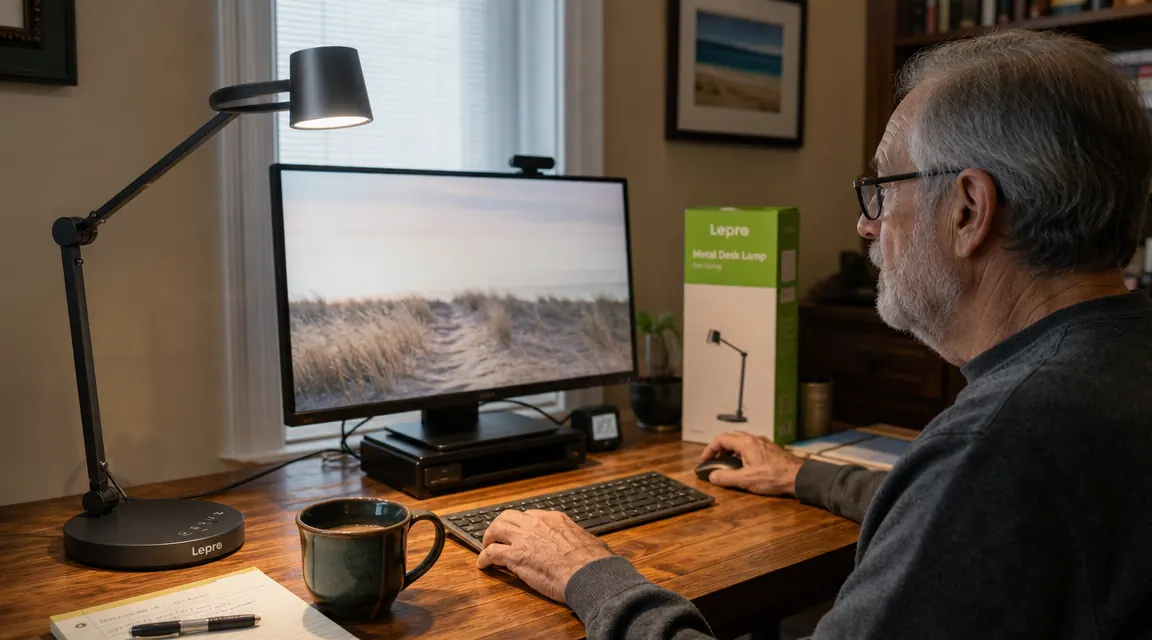
My setup was straightforward. A solid wood desk I built myself from some leftover red oak. A decent monitor. A cheap little clip lamp I grabbed at a hardware store for about twelve dollars, angled roughly at my desk because it seemed like the right thing to do. Lexi, my border collie, slept on her bed in the corner while I worked. Everything seemed fine except that I ended every day feeling like I'd been staring into the sun.
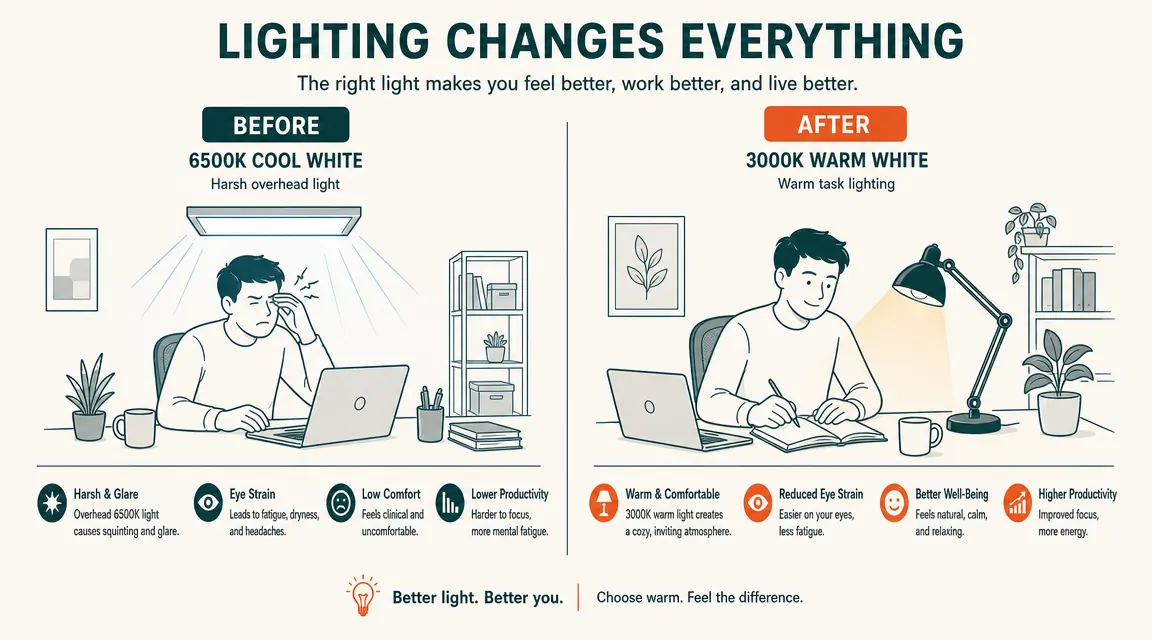
A neighbor of mine, Jim, he's a retired electrician and we talk shop sometimes, looked at my setup one afternoon and pointed right at the clip lamp. 'That thing is probably the whole problem,' he said. He explained that the cheap white LEDs in those hardware-store lamps put out a harsh blue-heavy light, high on the Kelvin scale, the kind your eyes read as midday sun even at seven in the evening. Your body never fully relaxes under that light. Your eyes keep bracing for more intensity that never comes. It's low-level strain, all day, every day.
I didn't want to spend a lot. The desk I built cost more than anything I've bought in years, and I wasn't about to drop a hundred and fifty dollars on a lamp. Jim mentioned he'd read about a metal task lamp from a company called Lepro, rated by Forbes for task lighting, under thirty dollars on Amazon. Five color temperature settings. Five brightness levels. A real arm with actual joint articulation. Metal construction, not plastic. I ordered it that night.
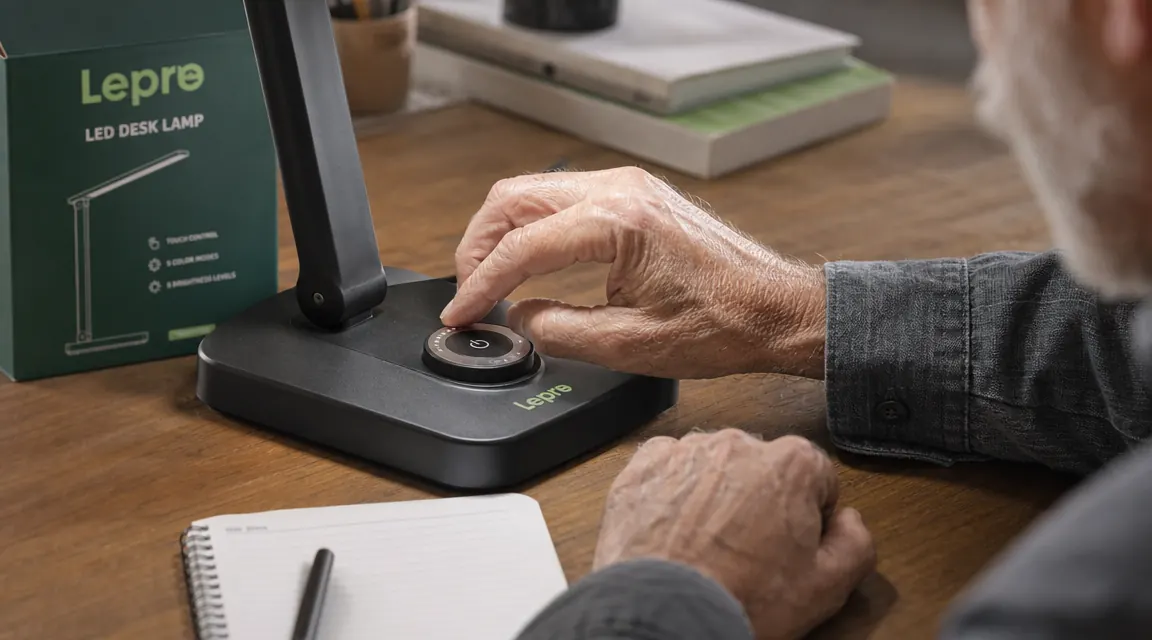
When it arrived I was honestly surprised by how solid it felt. I've handled enough hardware in my life to know when something is built right. The arm joints were firm, not loose and floppy. The head stayed exactly where I pointed it. The base was weighted enough to stay put on the desk without clamping. I set it up in about four minutes.
I switched it to the warm white setting and turned the brightness down two notches. That afternoon, for the first time in six months, I got to six o'clock without a headache.
Still squinting at a screen by mid-afternoon? Your lamp might be the whole problem.
The Lepro LED desk lamp is budget-friendly, ships with five color modes and five brightness levels, and is built from metal that actually holds its position. If end-of-day headaches are your normal, this is the fastest, cheapest fix worth trying.
Amazon Check Today's Price on Amazon →The warm white mode on the Lepro sits around 3000K. The neutral mode is around 4000K. The daylight mode pushes toward 6500K. I work mostly in warm white in the morning when I want to stay calm and focused, and I bump to neutral around midday when I need to read fine detail. I never use the daylight setting. My clip lamp was essentially stuck on daylight all the time with no way to adjust it. That's the whole story right there.
The dimmer matters too. Twenty-five percent brightness is my usual setting, aimed at the desk surface at about a thirty-degree angle so it lights the work area without bouncing back at the screen. No glare on the monitor, no shadows across the keyboard. Took me maybe ten minutes to find the right position and I haven't touched it since. I appreciate gear you set once and forget.
I'll tell you what I don't love. The cord is short, about five feet. On my desk it reaches the power strip just fine but I could imagine a setup where that's a problem. There's no USB charging port on the lamp itself, which some of the pricier desk lamps include. And the touch controls take a little getting used to, since there's no physical dial. After a week they feel natural, but the first day I kept accidentally changing modes when I meant to adjust brightness.
Those are real cons, and I'm telling you about them because that's what you'd want to know. But three months after I switched lamps, I realized I'd stopped tracking whether I had a headache. It just wasn't a thing anymore. When a problem disappears quietly, that's usually the best kind of fix.
If you want a deeper look at specs and long-term performance, I wrote a full review at the link below. And if you want to understand all the ways desk lighting can go wrong before you even pick a lamp, the piece on common desk lighting mistakes is worth reading first. Both are short.
Internal links: Lepro LED Desk Lamp Review and 5 Desk Lighting Mistakes That Cause Eye Strain.
What I'd Tell You If We Were Sitting at My Kitchen Table
If you're getting to the end of your workday with tired eyes or a low-grade headache and you're sitting under a cheap lamp or overhead fluorescents, I'd tell you to try the lamp first before you do anything else. Before you buy blue-light glasses, before you mess with monitor settings, before you schedule an eye appointment. A twenty-seven dollar metal lamp with adjustable color temperature is the cheapest possible test. If the headaches stop, you've found your answer. If they don't stop, you're only out thirty bucks and you still have a better lamp than the one you started with. That's a reasonable bet.
If the fix costs very little and it works, there's nothing to think about.
The Lepro LED task lamp is what I use every day. Metal build, five color modes, real brightness control. Worth every dollar for anyone dealing with end-of-day eye fatigue at a home desk.
Amazon Check Today's Price on Amazon →